
News
WindEurope opposes reopening of Birds and Habitats Directive
12 October 2026
Wind energy and nature protection go hand in hand. That was WindEurope’s message at the Brussels Night of Darkness. As Brussels switched off the lights, WindEurope launched a new booklet to shine a light on nature protection. Examples from across Europe illustrate how wind projects help protect nature and animals. Existing EU rules ensure strong biodiversity safeguards. Reopening these rules would create regulatory uncertainty – and leave nature worse off.
The greenhouse gas emissions driving climate change are putting up to 1 million species at risk of extinction and threatening ecosystems worldwide, according to WWF.
This makes the transition from fossil fuels to renewable energy and nature protection two sides of the same coin.
With the Environmental Omnibus package and a planned stress test of the Birds and Habitats Directives, the EU is now reviewing environmental legislation. The wind industry and environmental NGOs and alike warn that reopening the existing rules would create legal uncertainty and risk years of additional litigation and projects delays. The focus should therefore be on Member States’ correct implementation of existing rules. Greater administrative capacity in permitting authorities, combined with wider use of digital permitting tools and interoperable data systems, would accelerate permitting without compromising biodiversity standards.
As Ariel Brunner, CEO of BirdLife puts it: “Accelerating the deployment of renewable energy is an imperative, and it can be done without unacceptable damage to biodiversity. What we need is cooperation, innovation, and smart implementation of our good European laws. Ripping up the rule book means both undermining conservation efforts and creating uncertainty for responsible companies.Far from helping, it would be an own goal that sets everyone back.“
“The EU must not re-open the Birds and Habitats Directive. The rules allow for tailored solutions meeting the needs of individual sites. They are embedded in wind development. Reopening this legislation now would be terrible policymaking. It would mean years of discussion and messy compromises leaving nature and European energy security worse off”, says Pierre Tardieu, WindEurope’s Chief Policy Officer.
Nature protection is built into every project
Europe’s wind industry is committed to protecting nature. WindEurope’s new biodiversity booklet showcases that wind energy development goes hand in hand with protecting birds and habitats.
40 case studies from 19 European countries show how wind energy developers apply the mitigation hierarchy to avoid, minimise, restore and compensate any impacts. Many developers go further with voluntary and innovative biodiversity enhancement measures, delivering measurable net gains for nature and species.
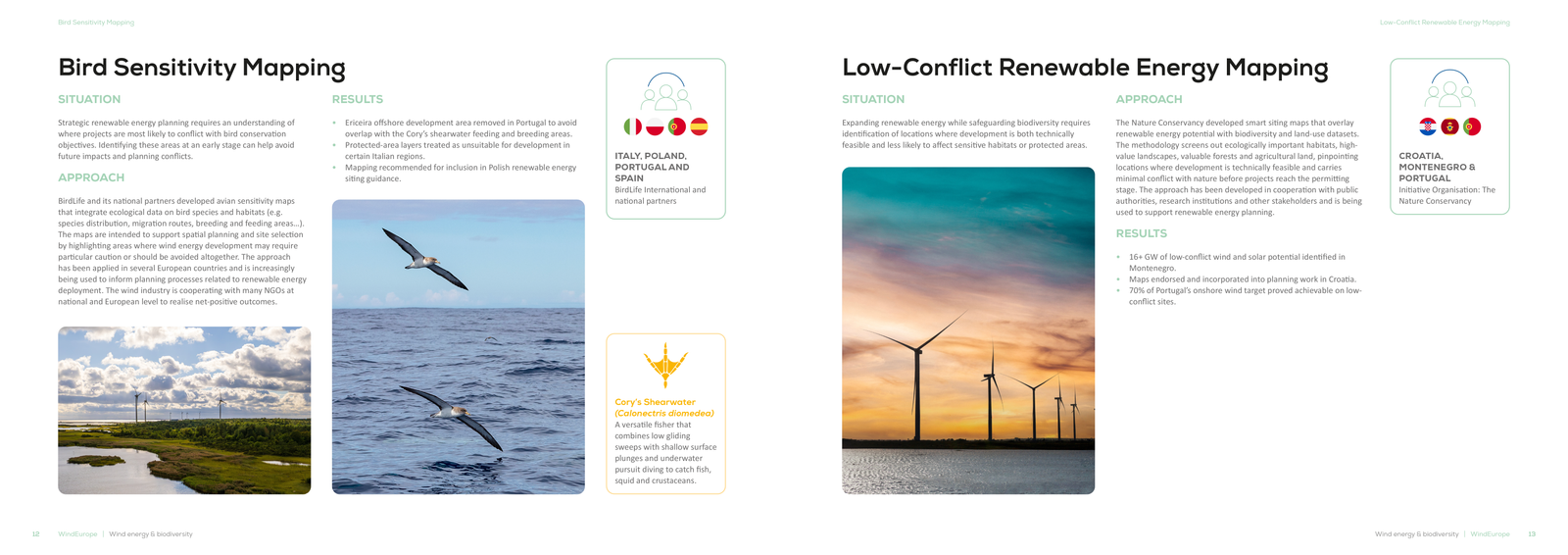
Thoughtful siting choices in France, noise reduction during construction in Germany, inspiring nature restoration measures in Ireland or innovative bird detection systems in Austria – the diversity of case studies illustrates that existing EU rules allow for a wide range of tailored mitigation and compensation measures. Some projects actively restore damaged ecosystems. In Greece, PPC Renewables is supporting the revival of threatened wetland habitats around Lake Karla, helping strengthen biodiversity and improve conditions for birdlife in an area of high ecological value.
For example, at the Andau wind farm in Austria, Burgenland Energie fitted a detection system developed with air navigation provider Austro Control. It uses radar and flight-plan data. The lights stay off unless an aircraft enters a zone of at least 8 km around the site. The result: lights off up to 90% of nights across 79 turbines.